

What Concept Screening is actually for
Most innovation pipelines have more concepts than they can fund. The development pipeline holds twenty, the NPD pipeline can support five, the commercial budget will back two or three. The question is not whether to filter; it is whether to filter against defensible consumer evidence or against internal preference and gut feel. Without the consumer-validated prioritisation, investment decisions get made on whichever concepts have the loudest internal champions, and the pipeline returns suffer from a selection bias the leadership team cannot defend in front of board, finance or investment committee scrutiny.
The structural problem is that most concept testing is either too qualitative (focus group reactions that cannot scale to investment decisions) or too generic (standard concept-testing methodologies built for FMCG broadly, not for food and drink specifically). Both fail at the same point: the decision-grade evidence needed to commit real investment is not what comes back. Either the sample size is too small, the metrics miss what actually matters for food and drink concepts, or the interpretation is too thin to support commercial recommendations.
Concept Screening is the structured testing methodology designed specifically to be the decision gate before commercial investment. Quantitative sample sizes that support board and investment committee scrutiny. Food and drink-specific metrics that capture what actually matters for concepts in this sector (occasion fit, brand permission, distinctive ownership, purchase intent in context, not just generic appeal). Senior food and drink interpretation alongside the quantitative work. Output structured for investment decisions rather than for descriptive reporting.
It is not the right tool for every brief. If the concepts are not yet developed enough to test credibly, Concept Labs is the right precursor: developing the concepts with consumers before they reach screening. If the brief is competitive comparison of many ideas at scale (a wider pool needing tournament-style methodology), Idea Testing is structurally different. If the brief is qualitative consumer reaction rather than quantitative prioritisation, focus groups or Concept Labs are more efficient. Concept Screening sits specifically when developed concepts need defensible prioritisation before investment.
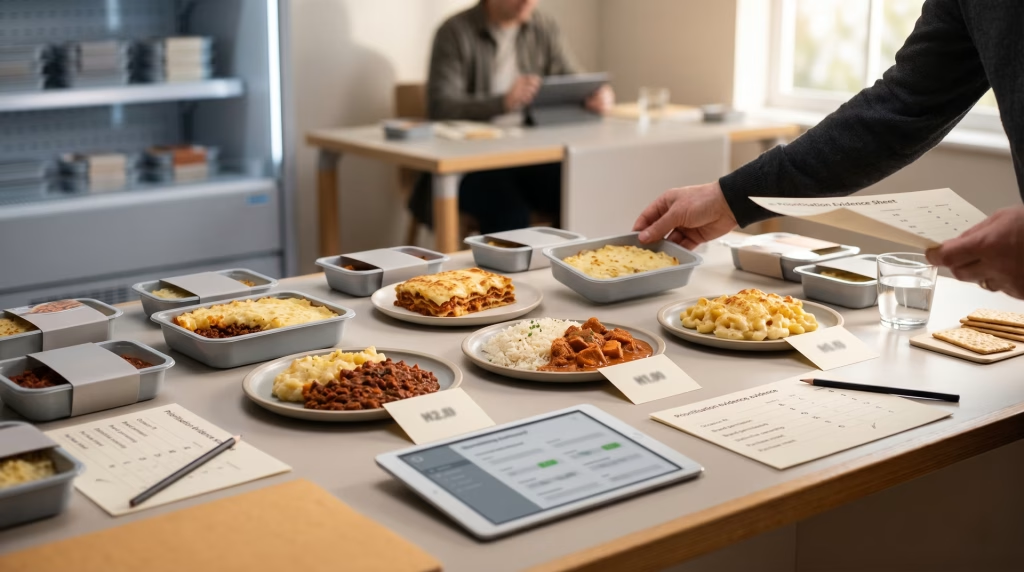
What we do differently
-
Decision-grade methodology, not generic concept research
The structural difference between testing built for commercial decisions and testing built for descriptive reporting. Our screening is scoped backwards from the decision the work has to support: which concepts go forward into NPD development, which propositions get commercial commitment, which directions get brand investment. The sample sizes, the metrics, the cuts and the synthesis are all built around the decision rather than against a generic concept-testing template. The output is procurement-grade and investment-grade rather than analytical.
-
Food and drink-specific metrics, not FMCG generics
Most concept testing applies generic FMCG metrics: appeal, uniqueness, purchase intent, brand fit. They work for some sectors. They miss what makes concepts succeed or fail in food and drink specifically: occasion fit, brand permission within the eating context, distinctive ownership against competitive set, role in the consumption repertoire, purchase intent measured against the actual moment rather than the generic question. Our metric framework is built around food and drink reality, which is why the screening results correlate more reliably with commercial performance in this sector.
-
Senior food and drink interpretation alongside the quantitative work
The technical difficulty of concept screening is reading what the scores actually mean for commercial decisions rather than taking the scores at face value. A concept that screens at the top on appeal might fail at launch for reasons the appeal score did not capture. Senior food and drink specialists interpret the screening data against the real commercial reality of the sector, which is the layer that separates useful screening from a chart pack of scores. We do not deliver decks of numbers without the interpretation that translates them into commercial direction.
-
Output structured for investment decisions, not for descriptive reporting
Every screening project closes with output scoped for the decision the work has to support: concept prioritisation against commercial criteria, defensible rationale for the recommendation, sizing implications, recommended sequencing for the priority concepts, transparent flagging of concepts that did not pass the screening bar. The deliverable is built for board, finance and investment committee scrutiny rather than for analytical internal consumption. The work pays for itself in the investment decision, not in the consumer evidence.
What we use Concept Screening for
Prioritising developed concepts for NPD investment
You have a set of developed concepts (typically from Concept Labs or from internal NPD work) and need defensible prioritisation before commercial investment is committed. Concept Screening tests the concepts at scale and delivers the prioritised set ready for NPD investment, with the rationale defensible against board or investment committee scrutiny.
Validating ideation output before commercial commitment
You have ideation output from Creative Workshops or Hothouse work and need to screen the concepts at scale before commercial commitment is made. Where the concepts are already developed enough to test directly (rather than needing Labs development first), Screening provides the consumer validation that closes the decision gate before investment.
Brand and campaign proposition screening
You are developing brand or campaign propositions and need consumer validation at scale to identify which propositions resonate most with the target audience before commercial commitment to direction. The screening surfaces the proposition winners and the rationale, in a form brand strategy and creative teams can build against.
Range concept screening for portfolio development
You are developing a product range across a portfolio brand and need range-level screening that handles both the individual concepts and the range coherence. The screening methodology surfaces both: which concepts work as individual propositions and which work as a coherent range, with the implications for range architecture explicit in the output.
Pre-investment evidence build for board or finance audiences
Your concepts need consumer-validated evidence before board, finance or investment committee will support the investment case. Concept Screening provides the structured evidence build, scoped for that audience: defensible sample sizes, transparent metrics, clear prioritisation logic, sizing implications grounded in consumer data rather than internal assumption.
Competitive concept screening (your concepts versus market alternatives)
Your concepts need to be tested not just against each other but against current market alternatives or competitive concepts. Competitive screening structures the testing to include the competitive set, with the prioritisation logic accounting for where your concepts win, where they tie, and where the competitive set has the structural advantage. The output supports investment decisions that account for competitive context rather than concept performance in isolation.
-
How a Concept Screening project runs
From developed concepts to defensible prioritisation
-
Scoping call.
Twenty minutes on a call. You tell us the concepts to screen, where they came from (Concept Labs, ideation work, internal NPD, brand agency), the investment decision the screening has to support, the audience for the deliverable (board, NPD committee, brand leadership) and the timeline. We tell you whether Concept Screening is the right tool, what sample size makes sense, what metrics the brief implies, and roughly what it will cost. Where the concepts need Labs development before they can be screened credibly, or where Idea Testing would suit the brief better, we will recommend that honestly.
-
Screening design.
The senior team designs the screening methodology specifically against the decision the work has to support: sample sizes, audience profiles and cuts, the food and drink-specific metric framework, the competitive context (where relevant), the cuts and the analytical approach. The design is signed off by the client before fieldwork starts, so the methodology is transparent and the analytical structure is agreed against the investment case the work feeds.
-
Fieldwork.
Quantitative research through specialist food and drink panels and trusted recruit partners. Sample sizes scoped to deliver decision-grade evidence (typically four hundred to one thousand consumers per concept depending on the cuts required, larger for sub-cut robustness or international work). Concept stimulus presented at appropriate fidelity for the screening question. Full quality checks throughout.
-
Senior synthesis and interpretation.
The senior team runs the analytical work and develops the interpretive layer: which concepts pass the screening bar, the rationale for prioritisation against the food and drink-specific metrics, the implications for development sequencing, the concepts that did not pass and the reasons why. The interpretation is what makes the screening commercially useful rather than just analytically complete, and is led by senior specialists who can read what the scores actually mean for commercial performance.
-
Decision-ready readout.
A working readout session walking the team through the prioritisation and the rationale, followed by the full deliverable: prioritised concept set, screening detail per concept, defensible rationale, sizing implications where relevant, recommended sequencing, transparent flagging of concepts that did not pass. The deliverable is built for the decision audience (board, NPD committee, brand leadership, finance) and lands within three weeks of fieldwork completion.
Five food and drink-specific screening metrics
Five metrics. The framework that makes concept screening predict commercial performance in food and drink. Generic FMCG metric frameworks miss what actually matters for food and drink concepts. The five metrics below are the framework we screen against, designed specifically around what predicts commercial performance in this sector. Some briefs add additional cuts (range fit, channel-specific intent, competitive comparison); the five below are the foundation.
Concept appeal and distinctive ownership
Concept appeal
The broad consumer interest signal: does the concept attract attention, does it have intuitive appeal, does it land in the consumer’s frame quickly. The foundation metric, but never used alone because high appeal without distinctive ownership or occasion fit predicts commercial under-performance more often than it predicts success.
Distinctive ownership
Whether the concept owns a clear, distinctive space rather than competing on the same ground as everything else in the category. The metric that separates concepts that can build commercial defensibility from concepts that get absorbed into broader category noise. Particularly important for food and drink where category crowding limits the headroom for undifferentiated concepts.

Occasion fit and brand permission
Occasion fit
How well the concept fits the specific eating or drinking moment it is designed for: breakfast routines, lunch behaviours, snacking patterns, evening meals, social occasions. The metric that captures whether the concept is built around real food and drink behaviour rather than category-level abstraction. The lens generic FMCG concept testing consistently misses.
Brand permission
Whether the brand has credibility for the concept in the consumer’s mind, not as a generalised brand attribute but specifically in the occasion and proposition context the concept addresses. The metric that flags concepts that are good ideas attached to the wrong brand, and concepts that need brand work before they can be commercialised.

Purchase intent in context
Purchase intent measured against the actual purchase moment the concept addresses (the specific channel, the specific occasion, the specific consumption context), not as a generic willingness-to-buy question. The metric that correlates most reliably with commercial performance in food and drink, because purchase intent in context strips out the abstract favourability that inflates standard purchase intent scores.

Food and drink is all we do
We are not a generalist research agency that takes the occasional food brief. Food and drink is the only sector we work in. Our senior team knows specifically how concept testing correlates with commercial performance in this sector, which categories the standard FMCG metrics work for and which they miss, and where the interpretation needs to push against the surface scores. Generic concept testing can deliver scores; sector specialists can read what the scores predict for commercial decisions.
That focus is why we work with 11 of the UK’s top 40 food and drink brands.
Other ways to create and refine ideas
Concept Screening is one tool in the broader Create and Refine Ideas toolkit. Depending on the brief, one of these might be a better fit, or a stronger partner alongside the screening work.
-
Concept Labs
Iterative concept development with consumers, structured to refine, sharpen and evolve concepts before they reach formal testing.
-

Idea Testing (Idea Arena)
A structured tournament-style testing methodology for food and drink ideas at scale.
-

Hothouse
Multi-day intensive ideation immersion for food and drink innovation, brand and commercial briefs at the highest commercial scale.
-

Creative Workshops
Senior-facilitated workshop ideation for food and drink innovation, brand and commercial briefs.

Concept Screening that earned investment commitment
Three real Concept Screening projects across different categories and different briefs.



FAQs
How is this different from Concept Labs?
Intent and methodology. Concept Labs is iterative development: concepts arrive in their initial form, get reworked across the session, leave in a sharper form. The methodology is qualitative-developmental. Concept Screening is structured testing: the concepts are fixed, the methodology is quantitative-comparative, the output is a prioritised set. The two are complementary tools at different stages of the same innovation flow. Concepts have to be Lab-ready before they are Screening-ready (developed sharply enough that quantitative testing produces a reliable read). Where the concepts are not yet developed, Labs is the right precursor; where the concepts are developed and need prioritisation, Screening is the right tool. Many programmes commission both in sequence.
How is this different from Idea Testing?
Scope and methodology design. Concept Screening is focused prioritisation: a defined set of developed concepts tested for which ones go forward, with the methodology built backwards from the investment decision. Idea Testing is competitive comparison at broader scale: many ideas tested against each other in a tournament-style structure, designed to identify winners from a wider pool. Different briefs need different methodologies. Where the concept set is defined and the decision is which to invest in, Screening is the right tool. Where the concept set is broader and the brief is identifying winners from across the pool, Idea Testing is structurally different.
How big does the sample need to be?
Depends on the cuts required and the decision the work supports. Typical UK screening samples are four hundred to one thousand consumers per concept, with larger samples for international work, sub-cut robustness (specific audience cuts requiring decision-grade evidence) or competitive screening (where the competitive set adds analytical complexity). We design the sample at scoping against the decision: investment committee scrutiny typically requires larger samples than internal NPD prioritisation; brand work typically smaller than commercial committal work. We will tell you straight what sample makes sense for your specific brief and your specific decision audience.
What metrics do you measure?
Five food and drink-specific metrics as the foundation: concept appeal, distinctive ownership, occasion fit, brand permission, purchase intent in context. Some briefs add metrics: range fit (for portfolio briefs), channel-specific intent (for category briefs), competitive comparison (where competitive concepts are tested alongside). The framework is built around food and drink reality rather than generic FMCG metrics, which is why the screening results correlate more reliably with commercial performance in this sector than generic concept testing does.
Can we rely on this for major investment decisions?
Yes, when the methodology is scoped properly against the decision the work supports. Screening with decision-grade sample sizes, food and drink-specific metrics and senior interpretation is structurally designed for board, finance and investment committee scrutiny. The output includes transparent methodology, defensible rationale, and clear flagging of confidence intervals and limitations. We will tell you straight at scoping what level of confidence the methodology will support for your specific decision, and we will not over-claim on the certainty of screening output. Concept screening is decision-support evidence, not a guarantee of commercial performance, and the deliverable is honest about that.
Can we screen concepts that have not been through Labs?
Sometimes, but not always. Concepts have to be developed enough that quantitative testing produces a reliable read. Concepts that are still in ideation form (in concept-title language, executional detail open, key boundaries unclear) will produce unreliable screening data because consumer reaction is being driven by interpretation gaps rather than by the concept itself. We will tell you straight at scoping whether your concepts are screening-ready, including recommending Concept Labs development first if they are not. Going to screening too early is the most common reason concepts fail testing for reasons that have more to do with concept maturity than with consumer interest.
What if no concepts pass the screening bar?
It happens occasionally, and the methodology is designed to surface this honestly rather than to manufacture passers. The deliverable surfaces all concepts in the screening, including the ones that did not pass and the specific reasons (appeal too narrow, distinctive ownership weak, brand permission missing, purchase intent in context too low). Where no concepts pass, the senior team will tell you straight rather than recommending the least-bad option, and will recommend the right next step (further Labs development, ideation rework, strategic re-scoping). The honest output is what makes the screening commercially useful to the buyer commissioning it.
How long does Concept Screening take?
Six to ten weeks from scoping call to decision-ready readout. Compressed timelines are possible where the methodology is straightforward (single-market, single-audience, focused concept set) and the fieldwork can run on existing panel infrastructure. More complex screening (international, competitive comparison, sub-cut analysis, large concept sets) typically runs ten to fourteen weeks. We give realistic timelines at proposal stage.
Can we run this internationally?
Yes. We run Concept Screening across the UK, mainland Europe, the US and the UAE, with sample structure and methodology adapted for each market. International screening has higher operational complexity than single-market work because the methodology has to handle cross-market comparability (for global decisions) or market-specific calibration (for local decisions). We will recommend the right approach at scoping.
How much does Concept Screening cost?
Project-based, scoped against the number of concepts, the sample size, the geographic scope, the depth of analytical work and the audience for the deliverable. Single-market UK screening of a focused concept set is the lowest entry point; multi-market competitive screening with full sub-cut analysis is the highest. We give a clear, all-in quote at proposal stage with no hidden extras, and we will tell you straight if your budget would buy better outcomes invested in a different combination of services.
Got developed concepts that need defensible prioritisation before investment commitment?
Tell us the concepts, where they came from, the investment decision the screening has to support, the audience for the deliverable, and the timeline. We will tell you whether Concept Screening is the right tool, what sample size makes sense, what metrics the brief implies, and what it will cost. Where the concepts need Labs development before screening or where Idea Testing would suit the brief better, we will recommend that honestly.