
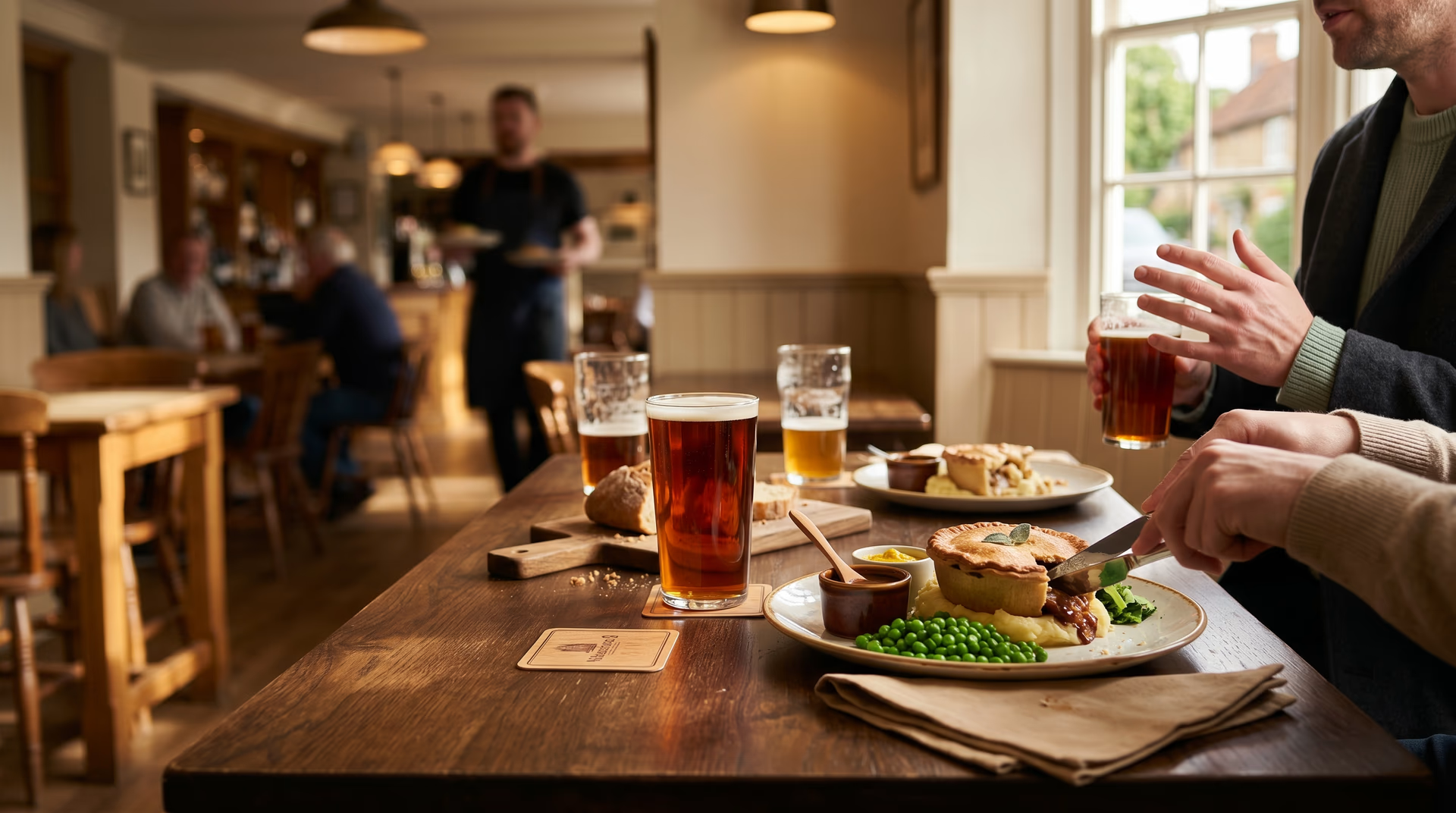
When the answer is what consumers cannot tell you, because they do not know they are doing it
Most food and drink research is built on what consumers tell you when you ask. The methodology is good for what it covers: stated attitudes, reported behaviour, conscious preferences. But food and drink behaviour is unusually rich in unconscious territory. Habits formed in childhood and never reconsidered. Household dynamics that shape what gets bought and by whom. The social meaning of the meal. The rituals that go unreported because they are invisible to the consumer themselves. The decisions made in the kitchen that the same consumer could not describe accurately twenty minutes later.
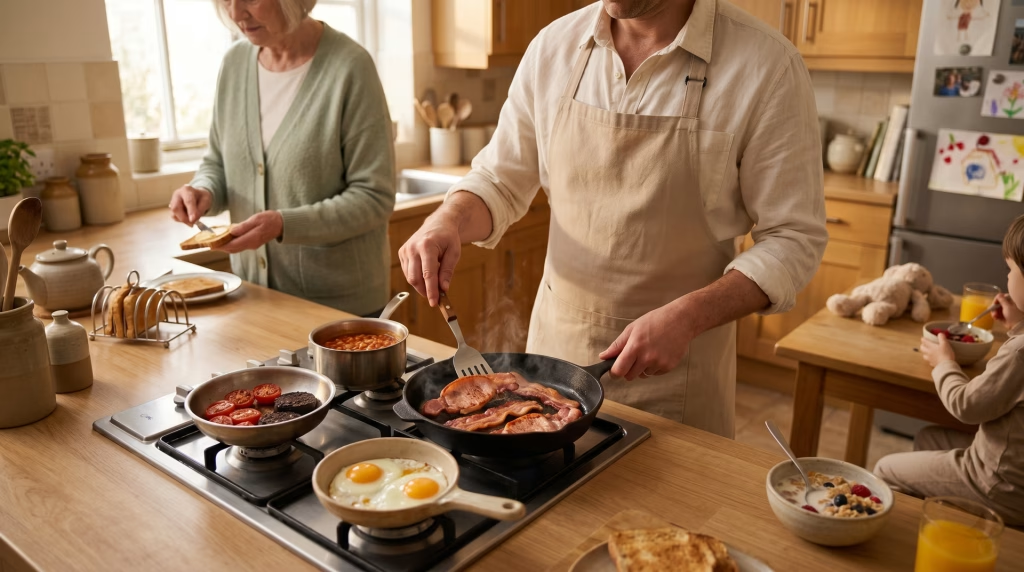
Ethnography is the structured methodology for surfacing what consumers cannot tell you. Senior researchers observe real consumers in real eating contexts: in their kitchens preparing meals, at their tables eating with families, in social occasions where food is the medium, in the everyday rituals that shape what gets consumed and when. The work is observational rather than facilitated. The samples are intentionally small because the depth is the value. The output is interpretation rooted in what was actually witnessed, not what was reported.
It is not the right tool for every brief. If the question is about stated attitudes or brand awareness at scale, U&A is better. If the question is shopping-specific, Shopper Explorations gives you the in-aisle depth ethnography is not built for. If the brief is about getting your team genuinely close to consumers with team involvement throughout, Consumer Closeness has the relational structure ethnography intentionally does not. If the brief is about specific stimulus reaction, focus groups will give you a faster answer.
What we do differently
-
Pure observation, with research stepping back rather than facilitating
The methodological distinction that defines ethnography. The researcher observes, captures and interprets rather than asking, prompting or moderating. The consumer behaves naturally because the research is not interrupting the behaviour. The work surfaces the unconscious patterns, habits and rituals that consumers cannot articulate in a session because they do not know they are doing them. This is the structural feature that separates ethnography from every other qualitative tool.
-
In context, not in a research setting
Every project runs in the consumer's natural environment: their home, their kitchen, their dining table, their social occasions, their everyday eating moments. The structural advantage is that the consumer's behaviour is not adapted to a research setting. They cook the way they actually cook, eat the way they actually eat, interact with food the way they actually do. The data is the lived reality, not the reported version.
-
Built around food and drink behaviour specifically
Most ethnographic methodology was developed for broader consumer behaviour: shopping, technology use, hospitality, transportation. Food and drink ethnography has its own specific shape. The kitchen as a working environment. The meal as a social and household ritual. The snack as a private moment. The occasion as a category-shaping unit. The household structure as the unit of analysis rather than the individual consumer. Our methodology is built around the way food and drink lives in real households, not against a generic ethnographic template.
-
Senior anthropological interpretation, not just description
Ethnographic fieldwork generates rich, contextual, behavioural data. Without senior interpretation it stays as description: detailed accounts of what was observed but no commercial meaning. The interpretive layer is where the work earns its keep. Our senior researchers have the social science depth and the food and drink specialism to read what they observe into commercially actionable understanding, and that interpretation is led by the senior team rather than delegated to junior researchers writing up fieldwork notes.
Six commercial use cases, written as scenarios a buyer will recognise from their own brief. The aim is for the reader to see their question on this list and self-select.
Brand stretch into new occasions or audiences
Your brand is moving into an occasion, audience or eating context where the team does not yet understand the behavioural reality. Ethnography surfaces what is actually happening in that context, in households the team has not been close to before, before strategy is set or NPD is briefed.
NPD for specific eating moments
You are developing NPD targeted at a specific eating context (breakfast on the go, family dinner, snacking at work, late-night eating, social occasions). Ethnography observes the lived reality of that moment so the NPD is built around what actually happens rather than around what is assumed about it.
Repositioning around cultural or generational shifts
You are responding to a cultural or generational shift in how the category is consumed (younger consumers cooking differently, household structures changing, occasion behaviour shifting, dietary habits evolving). Ethnography surfaces the new behavioural reality in lived form, before quantitative work scales it and after social signal has flagged it.
Understanding habit-driven categories
Your category is shaped by deep, unconscious habit: breakfast routines, hot beverage rituals, snacking patterns, evening meal logic, social occasion behaviour. Ethnography is one of the few methodologies that can surface habitual behaviour reliably, because consumers cannot report on habits they do not consciously notice they have.
Cross-cultural or international consumer understanding
You are entering or operating in a market where the consumer culture is structurally different from your home market. Food cultures vary widely, and translated consumer assumptions are commercially dangerous. Ethnography gives the team deep contextual understanding of the new market’s food culture before strategic decisions are made.
Pre-quantitative deep dive
Before commissioning U&A or segmentation, ethnography surfaces the hypotheses worth testing and the audience dimensions worth measuring. The result is quant work that asks better questions, scoped against richer behavioural understanding rather than against generic category assumptions.
-
How an ethnographic project runs
From brief to lived behavioural understanding
-
Scoping call
Twenty minutes on a call. You tell us the commercial question, the consumer context to observe, the audience to recruit, and the timeline. We tell you whether ethnography is the right tool, what observation format makes sense, what depth the brief requires, and roughly what it will cost.
-
Recruit and design
Specialist recruit through food and drink panels and trusted local recruiters. Properly briefed screeners, full quality checks. You sign off the recruit criteria, the consumer profiles and the observation protocol before fieldwork starts. The project is designed specifically around the context the work needs to capture, not against a generic template.
-
In-context observation
Senior researchers observe consumers in their natural eating environments: in their homes, in their kitchens, at their tables, in their social occasions. The observation runs across the agreed window (single-day for in-context observation, multiple visits for multi-household work, longer windows for longitudinal habit-driven studies). Photography and video capture run alongside the observation throughout, under the ethical protocols signed off at the start.
-
Senior interpretation
Senior researchers with social science depth and food and drink specialism synthesise across the households, surface the patterns and rituals that consumers cannot articulate, and turn the observation into commercially actionable understanding. The interpretive layer is the value, and we do not delegate it. This is the step where ethnography either earns its keep or fails to.
-
Working readout and recommendation
A working readout session, in person or by video, walking the team through what the observation surfaced and what we recommend. Photographic and video material from the fieldwork is provided alongside the written deliverable, because much of the value of ethnographic work is the team experiencing the observed reality rather than just reading the interpretation.
Single-day, multi-household, or longitudinal
The work flexes around the brief, the consumer context and the depth of behavioural understanding required. The three formats below are how clients most commonly commission ethnographic work. The decision shapes what the project looks like, how long it runs and what it costs.
Single-day in-context observation
Focused observation of a specific consumer moment or occasion (a meal preparation, a social occasion, a routine snacking moment), typically across six to ten households or contexts. Used for briefs anchored on a specific eating moment rather than on broader household behaviour. Typical commitment: four to six weeks from brief to readout, with the observation window concentrated in a single fieldwork phase.
Multi-household in-context study
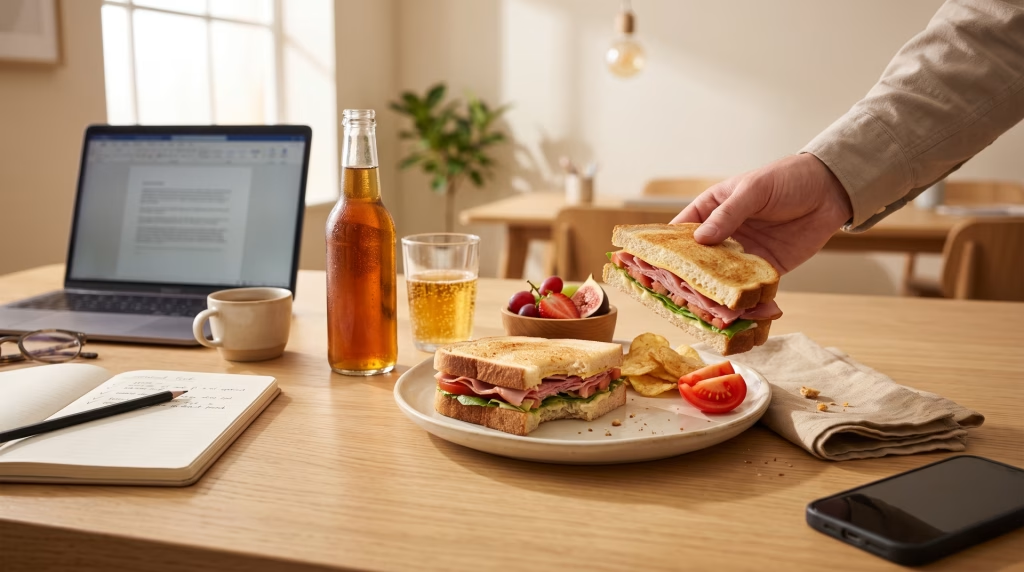
Deeper observation across eight to fifteen households, with multiple visits per household across different eating moments and contexts. The standard ethnographic format for most food and drink briefs, balancing depth per household with breadth across audience profiles. Typical commitment: eight to twelve weeks from brief to readout, with the observation window typically spanning two to four weeks of fieldwork.
Longitudinal household ethnography
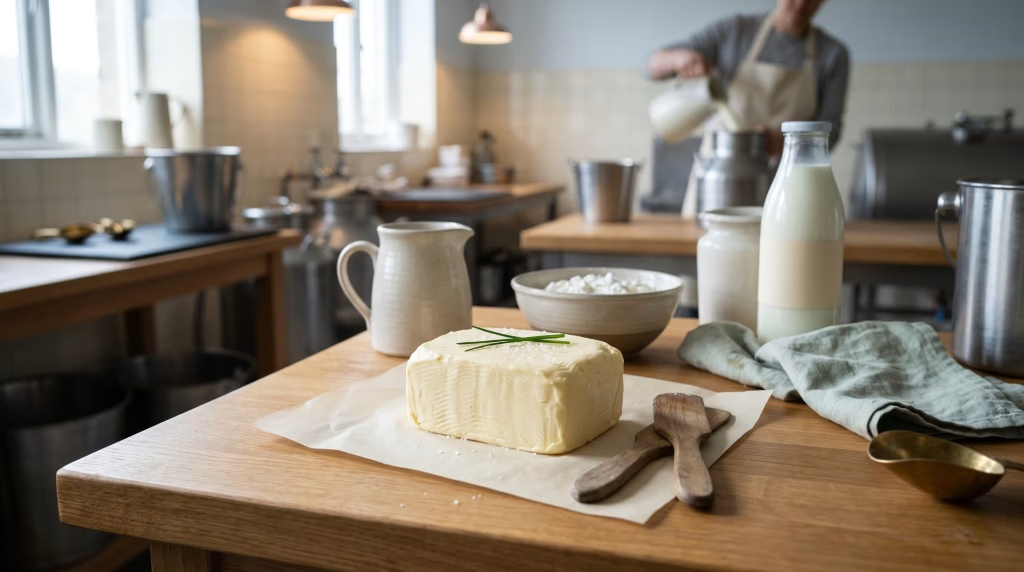
Sustained observation of a smaller set of households (four to eight) over an extended window (one to three months), used for habit-driven categories and behavioural-shift work where the patterns only surface across time. The richest ethnographic format, with the highest depth-per-household but the smallest sample. Typical commitment: three to six months end-to-end, scoped specifically to the category and the behavioural question.
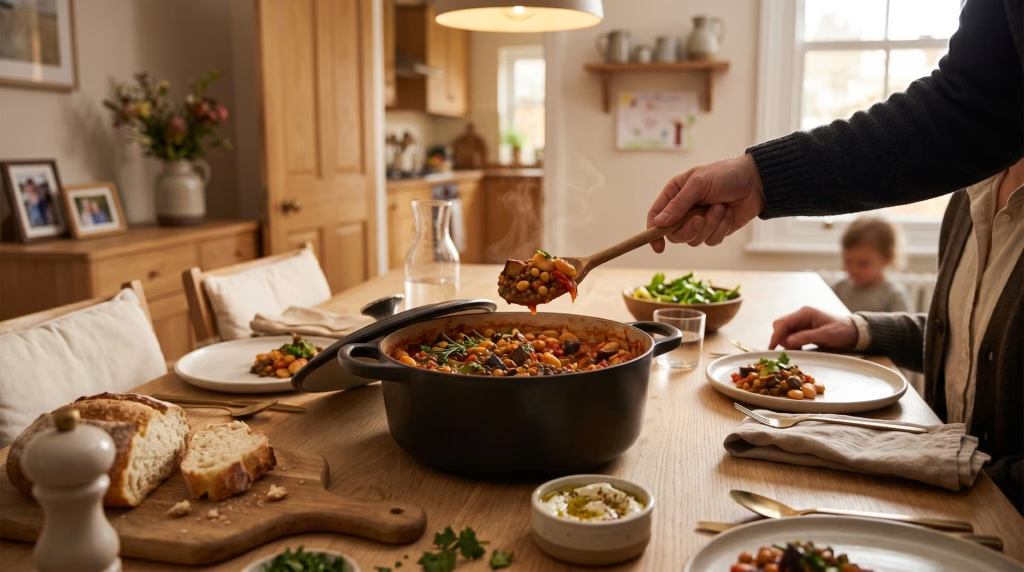
Food and drink is all we do
We are not a generalist ethnographic consultancy that takes the occasional food brief. Food and drink is the only sector we work in. Our senior researchers have the social science depth to do ethnographic work properly and the food and drink specialism to make it commercially actionable. The work lands with people who get it on the first read, and the interpretation comes back framed for the people who actually have to make the decision.
That focus is why we work with 11 of the UK’s top 40 food and drink brands.
Other ways to decode consumer behaviour
Ethnography is one tool in the broader Decode toolkit. Depending on the brief, one of these might be a better fit, or a stronger partner alongside the ethnographic work.
-
Consumer Closeness
Project-based consumer immersion that gets your team genuinely close to the consumers in your category over a defined window.
-
Usage and Attitude
Foundational quantitative consumer research that maps category usage, brand awareness, consumer attitudes and the drivers of choice across the audiences that matter.
-
Consumer and Category Data Immersion
Structured deep-dives that bring marketing, NPD, innovation or category teams up to a senior working understanding of the category, the consumer and the competitive landscape.
-
Opportunity Mapping
Strategic mapping of where to play in food and drink.

Ethnographic work that surfaced what no survey could
Three real ethnographic projects across different categories and different briefs.
FAQs
Why such small samples? Will the findings be credible?
Ethnography uses small samples by design, because the methodology trades breadth for depth. The work surfaces unconscious behaviour, household dynamics, social rituals and cultural meaning, which cannot be observed at survey scale. The findings are credible because they are rooted in directly observed behaviour rather than in reported response, and because the senior interpretation surfaces patterns across households rather than treating each household as a statistical unit. Where the brief needs scale validation, we routinely pair ethnographic work with quantitative U&A or segmentation to combine the depth with the breadth.
How is this different from Consumer Closeness?
Both methodologies involve sustained engagement with consumers, but they differ structurally. Ethnography is pure observation, with the research team stepping back and minimal client team involvement. Consumer Closeness is relational, with multiple touchpoint types (in-home, workshops, digital) and structural client team involvement throughout. Ethnography goes deeper observationally. Consumer Closeness gets the team closer and is more commercially flexible. Different tools for different briefs. Many programmes use both: ethnography for foundational behavioural depth, Consumer Closeness for ongoing team-consumer connection.
How is this different from Shopper Explorations?
Shopper Explorations is shopping-specific: accompanied shops, store observation, pre and post-shop interviews, digital shopper journey. Ethnography is broader: consumer behaviour across eating and life contexts, including but not limited to shopping. Most ethnography projects do not go deep on the shopping moment in the way Shopper Explorations does. Most Shopper Explorations projects do not capture the upstream household and occasion context that ethnography does. The two are complementary tools for different briefs.
How long does an ethnographic project take?
Depends on the format. Single-day in-context observation typically runs four to six weeks from brief to readout. Multi-household in-context studies (the standard format) typically run eight to twelve weeks. Longitudinal household ethnography runs three to six months end-to-end. We give realistic timelines at proposal stage based on the format and the depth the brief requires.
What ethical protocols do you follow?
All work runs under formal ethical protocols agreed at the start of the project: informed consent for observation, photography and video; appropriate handling of household and family contexts (including children where present); right-to-withdraw at any stage; secure handling and storage of all observational material; agreed protocols for any subsequent use of imagery beyond the immediate project. Our senior team is experienced in research ethics specific to in-home and behavioural observation work.
Can our team observe alongside the researchers?
Sometimes, but not always. The ethnographic methodology depends on the consumer behaving naturally in their own environment, and a larger group of observers (including client team alongside the senior researcher) often changes how the consumer behaves. Where the brief allows it, the client team can join specific moments (typically de-briefs or selected observation visits). Where the work depends on minimal observation footprint, client team involvement is added through observational material capture and working sessions during the analysis phase. We will recommend the right level of team involvement on the scoping call.
Can we run this internationally?
Yes. We run ethnographic projects across the UK, mainland Europe, the US and the UAE, with local recruit, local fieldwork support where the language and cultural context need it, and senior FIS Group oversight throughout. International ethnographic work is particularly valuable when the consumer culture is structurally different from the home market, because translated consumer assumptions are commercially dangerous and ethnography surfaces what the assumption misses.
Who actually runs the ethnographic fieldwork?
Senior researchers with social science depth and food and drink specialism. The senior person you meet on the scoping call is the same person who runs the fieldwork and interprets the work. No handover to a junior researcher mid-project, because ethnographic interpretation depends on continuity between observation and analysis.
What do we get at the end?
A working readout session with the team, a structured written deliverable scoped for the audience, and the photographic and video material from the fieldwork. Much of the value of ethnographic work is the team experiencing the observed reality rather than just reading the interpretation, so the observational material is provided alongside the written work where the audience needs it. Format agreed at the start.
How much does it cost?
Project-based, scoped against the format, the number of households, the depth of observation and the geographic scope. Single-day in-context observation work is the lowest entry point; longitudinal multi-market household ethnography is the highest. We will give you a clear, all-in quote at proposal stage with no hidden extras.
Got a question that needs answering in real life, not in a research setting?
Tell us the commercial question, the consumer context to observe, the audience to recruit, and the timeline. We will tell you whether ethnography is the right tool, what format makes sense, what depth the brief requires and what it will cost. Twenty minutes on a call. No qualifying call before the qualifying call.
Senior researchers with social science depth. Observation in real contexts. Anthropological interpretation. Specialists in food and drink, only.