
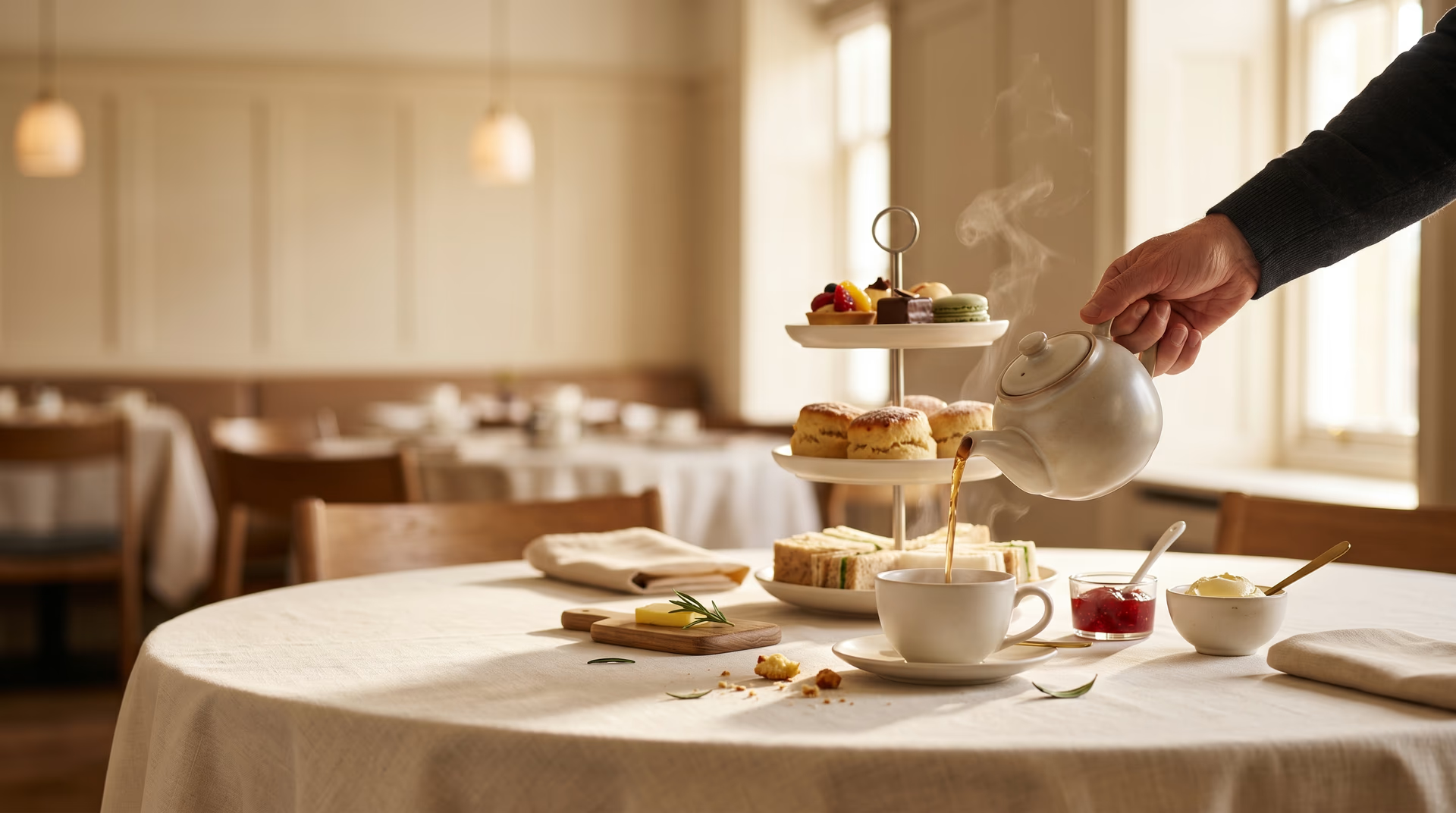
When the decision needs a defensible quantitative foundation, not just an informed view
Most major commercial decisions in food and drink sit on a quantitative baseline. Who uses the category and how often. Which brands are known, considered, used, lapsed and rejected. What attitudes shape choice. What demographic and behavioural patterns sit underneath the category. The decisions get made anyway. The question is whether they are made against a defensible quantitative picture, or against assumption dressed as evidence.
U&A is the structured quantitative foundation for that picture. The work measures category usage, brand performance, consumer attitudes and the drivers of choice across the audiences that matter for your specific commercial question. Our work is structured around food and drink occasions rather than against generic FMCG templates, because the occasion is the unit of behaviour that actually matters in this sector. Breakfast at home is not the same as snacking at work. Dinner with family is not the same as drinks with friends. A methodology that treats them as a single category-level statistic misses what makes commercial decisions in food and drink defensible.
It is not the right tool for every brief. If the question is about cultural and behavioural signal that has not yet landed in the data, social scraping is the better fit. If the question needs deep qualitative consumer understanding, consumer closeness or ethnography go further than quantitative work can. If the brief is specifically about audience grouping rather than category baseline, segmentation may be the natural starting point. We will tell you straight on the scoping call which is the right call.

What we do differently
-
Built around food and drink occasions, not generic FMCG templates
Most U&A frameworks were built for FMCG broadly (laundry, toiletries, food and drink grouped together) and applied to food and drink as one category among many. The methodology misses what makes food and drink commercially specific: the occasion is the most useful unit of analysis, not the category as a whole. Our work is built around occasion frameworks specific to food and drink (breakfast, lunch, dinner, snacking, on-the-go, drinks), which means the data reads against the unit of behaviour that actually shapes commercial decisions in this sector.
-
Senior interpretation, not data tables and a chart pack
Most U&A deliverables land as a tables file and a 200-slide chart pack for the client team to mine themselves. We deliver structured interpretation: what the data shows, what it means for the commercial question, what we recommend you do next. The senior interpretive layer is the value, and we do not delegate it. The data tables come with the work; they do not replace the recommendation.
-
Integrated with the rest of the toolkit, not stand-alone
U&A rarely sits on its own in serious commercial work. We routinely integrate U&A with the qualitative side (Consumer Closeness, Ethnography), with secondary data (Data Mining), with cultural signal (Social Scraping) and with the curated synthesis layer (Consumer and Category Data Immersion). The integrated cross-source view is far more defensible than U&A alone, and most strategic decisions in food and drink benefit from the triangulation.
-
Action-oriented output, not descriptive reporting
Every U&A project closes with a clear commercial recommendation against the original brief. What we found, what it means for the decision, what we recommend you do next. Built for the people who have to act on the work, not for the analyst who will mine it for the next six months. The data is in the appendix; the recommendation is in the readout.
Six commercial use cases, written as scenarios a buyer will recognise from their own brief. The aim is for the reader to see their question on this list and self-select.
Category baseline before major strategy work
You are starting (or restarting) a major piece of strategic work and need a defensible quantitative picture of who uses the category, how, when, where and why. The U&A is the structured foundation the strategy work sits on, scoped specifically to the commercial questions the strategy has to answer.
Audience and occasion sizing for investment cases
You are building a commercial case for a major investment (NPD launch, market entry, brand stretch, acquisition target) and need defensible audience and occasion sizing. The U&A delivers the structured quantitative picture in a form that board, finance, retail buyer or investment committee audiences will accept.
Brand health and equity diagnosis
Your brand performance is shifting and you need a structured quantitative read on where it sits versus competitors, what is driving the movement, and where the leverage points actually are. Built specifically as a diagnostic, with the implications for brand strategy made explicit in the readout.
Drivers of choice and rejection analysis
You need to understand specifically what drives consumers to choose your brand versus competitors, what drives rejection and lapsing, and where the levers for change actually sit. The U&A is scoped specifically as a driver study rather than as a general category baseline.
Pre-segmentation foundation
Before commissioning a full segmentation, the U&A delivers the structured category and audience baseline that the segmentation work will then refine into actionable groupings. The two tools together are far stronger than either alone, and the U&A is scoped to feed cleanly into the segmentation that follows.
Refreshing dated U&A from another supplier
You have inherited a U&A from a previous supplier or an old internal project, the data is now too old to defend in front of the audience that has to act on it, and you need a refreshed version built to a defensible methodology. We will tell you straight what can be picked up from the dated work and what needs to be rebuilt against current behaviour.
-
How a U&A project runs
From commercial question to defensible quantitative foundation
-
Scoping call
Twenty minutes on a call. You tell us the commercial question, the audiences that need to be covered, the brands and categories in scope, the channels and occasions that matter, and the timeline. We tell you whether U&A is the right tool, what sample structure makes sense, what methodology choices the brief implies, and roughly what it will cost.
-
Methodology design
Sample plan, questionnaire design, occasion framework, fieldwork approach. The senior team designs the methodology specifically around the commercial question rather than against a standard U&A template. The key methodology choices (sample size, audience boosts, occasion framework, channel coverage) are made transparent and signed off by you before fieldwork starts.
-
Fieldwork
Online, mixed-mode or face-to-face as the brief requires, run through specialist food and drink panels and trusted recruit partners. Full quality checks throughout: screener integrity, response quality, panel performance, sample balance. You receive fieldwork progress updates so the work is transparent throughout, not just at delivery.
-
Senior analysis
The senior team runs the analysis against the agreed framework, with cross-cuts and depth where the commercial question requires. The analysis is structured around the question the work has to answer rather than against a methodology template, which means the cuts that matter for your decision are surfaced rather than buried in a generic chart pack.
-
Working readout and deliverables
A working readout session, in person or by video, walking through what the data surfaced and what we recommend. Followed by a clean shareable deck for the wider team, the full data tables file for the in-house team to interrogate, and the working data set the team can continue to use beyond the project.
Five lenses. One integrated picture.
A U&A study covers the structured baseline across five core analytical lenses. The mix is scoped against your specific commercial question, but the integrated picture across all five is what most strategic decisions in food and drink actually need to land defensibly.
Category usage and Brand awareness, consideration and use
Category usage
Penetration, frequency, occasion behaviour, who uses the category and when, how the usage is changing over time, what drives consumption frequency. The structural baseline most decisions sit on, scoped around food and drink occasions rather than around a generic category metric.
Brand awareness, consideration and use
Awareness, consideration, current use, lapsed use, rejection. The consumer’s brand repertoire and how the brand performs within it. The brand performance layer that matters for commercial decisions on brand health, brand stretch and competitive response.
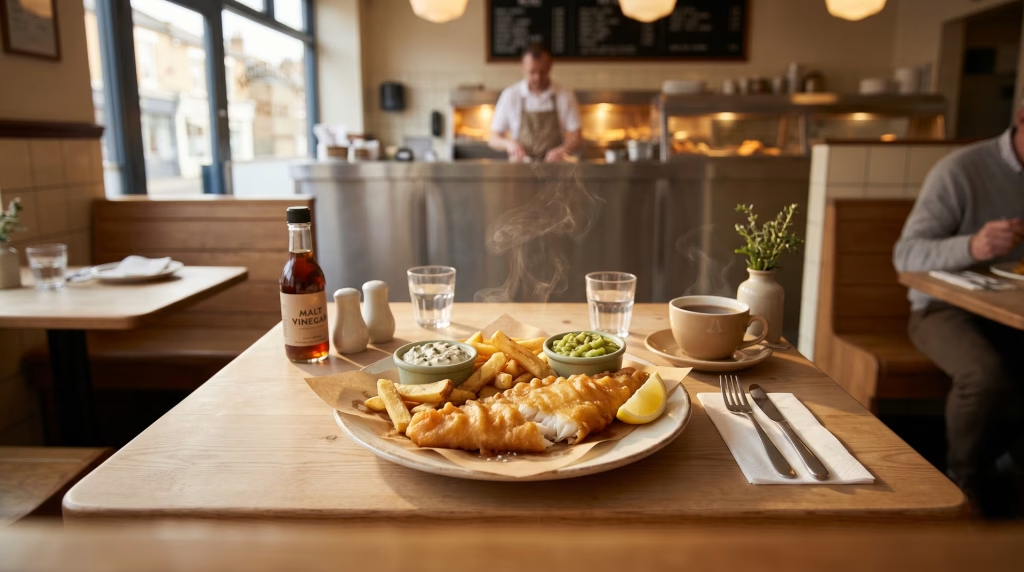
Attitudes and perceptions and Drivers of choice and rejection
Attitudes and perceptions
Attitudes toward the category and the brands within it, perceived strengths and weaknesses, image associations, the consumer’s mental map of the category. The qualitative-rich layer inside the quantitative study that explains the behavioural numbers rather than just reporting them.
Drivers of choice and rejection
What actually drives consumers to choose, switch and reject brands. Cross-tabulated against usage and brand awareness so the driver analysis lands as commercially actionable rather than as a generic driver list. The layer most often skipped in syndicated U&A, and the layer most useful for brand strategy decisions.
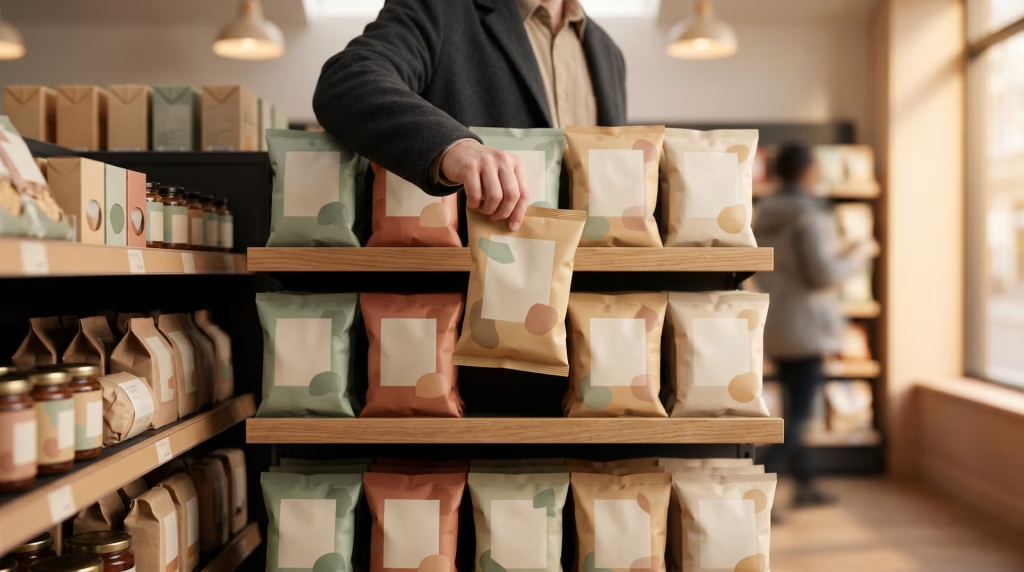
Audience profile and segmentation foundation
Demographic, psychographic and behavioural profiling of users versus non-users, heavy users versus light users, loyal versus switcher. The structured audience layer that feeds into segmentation work where it follows, and that gives the rest of the U&A its actionable audience-level depth.

Food and drink is all we do
We are not a generalist quantitative agency that takes the occasional food brief. Food and drink is the only sector we work in. Our senior researchers know the categories, the consumers, the occasions, the channels and the panel structures. Briefs land with people who get it on the first read, and the methodology is built specifically for the commercial reality of this sector, not against an FMCG template that treats food and drink as a single category statistic.
That focus is why we work with 11 of the UK’s top 40 food and drink brands.
Other ways to build the quantitative foundation
U&A is one tool in the broader Decode toolkit. Depending on the brief, one of these might be a better fit, or a stronger partner alongside the U&A work.
-
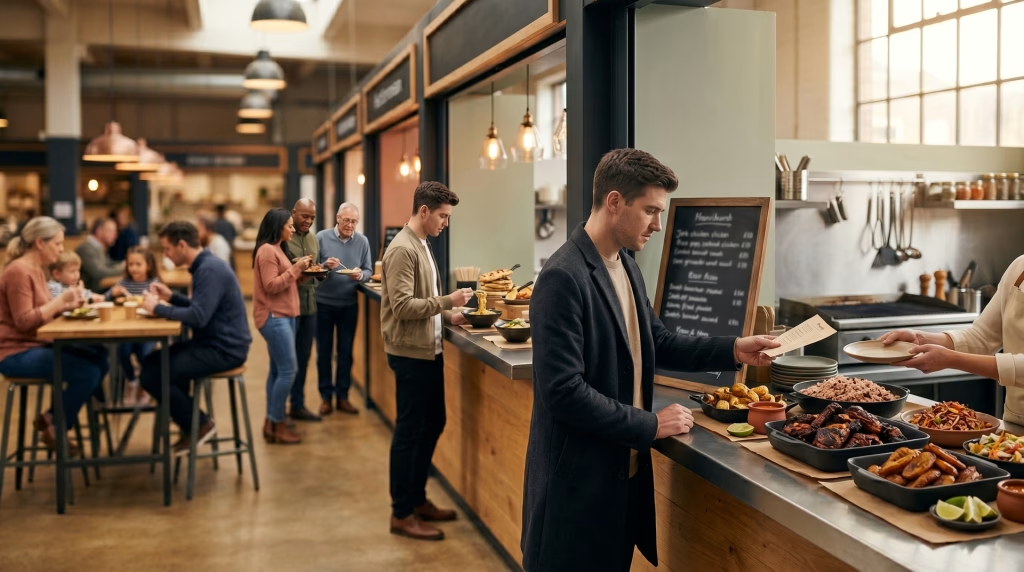
Segmentation
Structured consumer segmentation that produces actionable audience groupings, not descriptive profiles that gather dust.
-
Consumer Closeness
Project-based consumer immersion that gets your team genuinely close to the consumers in your category over a defined window.
-
Consumer and Category Data Immersion
Structured deep-dives that bring marketing, NPD, innovation or category teams up to a senior working understanding of the category, the consumer and the competitive landscape.
-

Opportunity Mapping
Strategic mapping of where to play in food and drink.

U&A studies that earned their commercial place
Three real U&A projects across different categories and different briefs.
FAQs
How is this different from buying syndicated U&A from Kantar, Nielsen or similar?
Syndicated U&A is built to a standard questionnaire and methodology, sold to multiple clients, and structured around the panel provider’s framework rather than around your specific commercial question. Our work is bespoke: scoped around your audiences, your brands, your occasions, your channels and your specific decision. The base measurement methodology is comparable; the commercial usefulness is structurally different. Some clients use both: syndicated for always-on industry baseline, bespoke U&A for the specific commercial decisions where the standard framework misses what matters.
How is U&A different from a tracking study?
A U&A is a foundational baseline measurement, typically run as a one-off or refreshed periodically (every two to three years). A tracking study is ongoing measurement of brand or category performance over time, usually quarterly. The two are complementary: U&A delivers the deep baseline, tracking maintains visibility on movement against that baseline. Many businesses commission U&A first, then set up tracking against it.
How long does a U&A study take?
Eight to twelve weeks from scoping call to readout is the typical window for UK-only single-market work. Compressed timelines are possible where the sample is straightforward and the questionnaire is short. Larger international studies, complex audience boosts or detailed driver analysis can extend to twelve to sixteen weeks. We give realistic timelines at proposal stage.
What sample size do we need?
Depends on the question and the audiences you need to cover. A general UK category baseline typically needs 1,000 to 1,500 consumers. Audience-specific work (heavy users, specific demographics, occasion-led cuts) may need targeted boosts on top. International work scales by market. We will recommend the right sample for your specific brief at the scoping call rather than push a default.
Will the data be statistically robust enough for investment decisions?
Yes, where the sample design and methodology are properly scoped for the audience question. We will tell you straight at the scoping stage what level of confidence the proposed sample will support and what depth of audience cut is statistically credible at that sample size. We do not over-claim on statistical robustness, and we will recommend a larger sample if the decision genuinely requires it.
Can we run this internationally?
Yes. We run U&A studies across the UK, mainland Europe, the US and the UAE, with sample structure and methodology adapted for each market. International work takes longer than UK-only because of the multi-market coordination, but the methodology and quality standards travel.
Can we add custom modules to a standard U&A?
Yes. Most of our U&A work includes custom modules scoped to the specific commercial question: brand health diagnostics, driver analysis, concept screening, segmentation foundation work, occasion deep-dives. The modular design is one of the things that separates bespoke U&A from syndicated, and it is built into the methodology design step rather than added as an afterthought.
Can we integrate U&A with our existing data?
Yes. We routinely integrate U&A primary data with internal CRM and sales data, with syndicated panel data (Kantar, Nielsen, Circana) and with our own proprietary sources. The integrated cross-source picture is far stronger than U&A alone, and most serious commercial decisions in food and drink benefit from the triangulation. Often handled as a separate Data Mining engagement alongside the U&A.
Should U&A be refreshed annually?
Usually not. A well-scoped U&A is a foundational baseline that should hold for two to three years in most categories. Where the category is shifting fast or where the brand is going through a major change, more frequent refresh may be justified. Tracking studies (lighter, more frequent) are the right tool for between-refresh measurement. We will tell you straight what cadence fits your category.
How much does U&A cost?
Project-based, scoped against sample size, audience complexity, methodology, geographic scope and the depth of analysis. Single-market UK baseline U&A is the lowest entry point; complex multi-market work with audience boosts and detailed driver analysis is the highest. We give a clear, all-in quote at proposal stage with no hidden extras, and we will tell you straight if your budget will not buy the depth your brief requires.
Got a commercial decision that needs a defensible quantitative foundation?
Tell us the commercial question, the audiences that need to be covered, the brands and occasions in scope, and the timeline. We will tell you whether U&A is the right tool, what sample structure makes sense, what methodology choices the brief implies and what it will cost. Twenty minutes on a call. No qualifying call before the qualifying call.
Senior food and drink specialists. Built around occasions, not generic templates. Action-oriented output. Specialists in food and drink, only.