

When the question needs an operator’s read, not an analyst’s
QSR is a structurally specific channel. The unit economics are different, the menu architecture works differently, the operational throughput is different, the supply chain pressures are different, and the consumer proposition lives in a different commercial logic than retail, foodservice or hospitality. A generalist review will catch the visible signals (the menu, the marketing, the consumer-facing brand) but will miss the operational reality underneath: the kitchen flow that makes the throughput possible, the supply chain decisions that make the unit economics work, the real estate model that drives the rollout shape.
QSR operation review is the structured, multi-lens read of all of it. The work covers operations and unit economics, menu architecture and food, brand and consumer proposition, supply chain and procurement, real estate and operational replicability. Run by senior specialists with primary QSR operating experience, not by analysts who have read about the channel. Used by competitor brands, acquisition teams, private equity, and brands considering entry into QSR from another channel.
It is not the right tool for every brief. If the question is about the broader category or about consumer-facing trends, immersion work or social scraping is the better fit. If the question is about a single competitor across multiple channels (not specifically QSR), a food safari with competitor focus may be more useful. We will tell you straight which is the right call on the scoping call.

What we do differently
-
Senior operators, not analysts
The senior people on every QSR review have run the operations they are now reviewing. Buyers, NPD leads, operations directors, supply chain heads, real estate principals. The work is read through the lens of someone who has actually made the operational decisions, not someone who has read about them. This is the single biggest gap between us and generalist M&A advisory on QSR work, and the reason buyers come back.
-
Operations-first, not consumer-first
Most reviews of QSR brands start with the consumer proposition and the brand. Ours starts with the operations: throughput, unit economics, supply chain reliability, real estate model. The consumer and brand work matters and is covered fully, but the operational read is what separates a credible review from a marketing-flavoured one. The order matters in QSR specifically because the operations are the proposition.
-
Primary observation where the brief allows
Where the brief allows, we run primary site visits in the operator's estate: peak service observation, off-peak observation, multi-unit comparison to read the operational standard across the estate rather than against a single flagship. Most reviews skip this because it is operationally harder and more expensive. We do it because the operational signal lives in the variance across the estate, not in the press release.
-
Discretion where it matters
Acquisition work, competitive intelligence and PE diligence all require discretion in how the work is run and how the team is briefed. Our protocols are designed for this. We work under NDA throughout, the senior team is small and named on the engagement, primary observation is run without the operator being aware where that is the brief, and the deliverable is built for the audience that has to see it (board, deal team, investment committee) without surfacing more widely than agreed.
Six commercial use cases, written as scenarios a buyer will recognise from their own brief. The aim is for the reader to see their question on this list and self-select.
Competitive review against a specific QSR brand
You operate in QSR and a specific competitor is moving in your category, your region or your price tier. The review builds the live operational picture: what they are doing, how their unit economics actually work, where their estate is genuinely strong and where it is exposed, and what that means for your competitive response.
M&A target evaluation
You are evaluating a QSR acquisition target. The review is structured as commercial diligence: operational reality across the estate, unit economic credibility, menu and supply chain risk, real estate and replicability for the rollout case, organisational capability behind the public numbers. Designed to feed directly into the deal team’s evaluation.
Private equity portfolio review
You hold QSR assets in your portfolio and need an operationally credible read on performance, headroom and exposure. The review is run across one operator or several, with the output structured for portfolio management rather than for headline reporting.
Channel entry assessment
You operate in another channel (retail, foodservice, hospitality, FMCG) and are considering entry into QSR. The review benchmarks the operators you would be competing against and the operational realities you would have to match, so the entry decision is made against the actual operational standard rather than against the consumer-facing brand.
Operational benchmarking against best-in-class
You operate in QSR and want a structured external read on where your estate sits against best-in-class operators in the same tier or category. The review reads your operation alongside two or three benchmark operators across the same lenses, with the gaps surfaced in a form your operations team can actually work with.
International QSR market entry
You are considering entry into a new geographic market and need an operational read on the QSR operators already in that market. The review runs in territory (mainland Europe, the US, the UAE or further afield), benchmarks the incumbent operators and reads the operational reality you would have to enter against, not the marketing version.
-
How a QSR review runs
From brief to operationally credible read
-
Scoping call
Twenty minutes on a call, under NDA from the start if the brief requires it. You tell us the operator (or operators) to be reviewed, the commercial question the review has to inform, and the level of discretion required. We tell you whether a QSR operation review is the right answer, what depth makes sense, what we can credibly cover, and roughly what it will cost.
-
Desk intelligence build
The senior team builds the desk-based intelligence layer: financial filings, trade press, real estate filings, supplier relationships, operational signal from public and proprietary sources. This is the structured foundation that the primary observation and the senior interpretation will sit on top of.
-
Primary observation
Where the brief allows, we run primary site visits across the operator's estate. Peak service, off-peak, multi-unit comparison, mystery shopping at the operator and at the benchmark comparison set. Run discreetly where discretion is part of the brief. This is the operational reality layer that separates our review from desk-only work.
-
Cross-functional synthesis
Senior specialists synthesise the work across the five operational lenses (operations, menu, brand and consumer, supply chain, real estate and replicability). The cross-functional read is the part most generalist reviews skip, and the part that lands as commercially useful for sophisticated buyers.
-
Debrief and recommendation
A structured debrief session, in person or by video, with the audience that has to act on the work (deal team, board, investment committee, leadership). Followed by the written deliverable, scoped and formatted for that audience. The review closes with a recommendation against the original commercial question, not with a market overview.
Five operational lenses. One integrated read.
The work covers the full operational picture, not just the visible consumer-facing layer. The five lenses below are run together (not separately) so the integrated commercial read survives the diligence process.
Operations and unit economics and Menu architecture and food
Operations and unit economics
Throughput, peak service performance, labour model, kitchen flow, technology stack, unit economics, profitability variance across the estate. The operational reality underneath the brand.
Menu architecture and food
Menu engineering, item-level margin, complexity load, food quality variance across the estate, NPD pipeline credibility, range coherence with the consumer proposition.
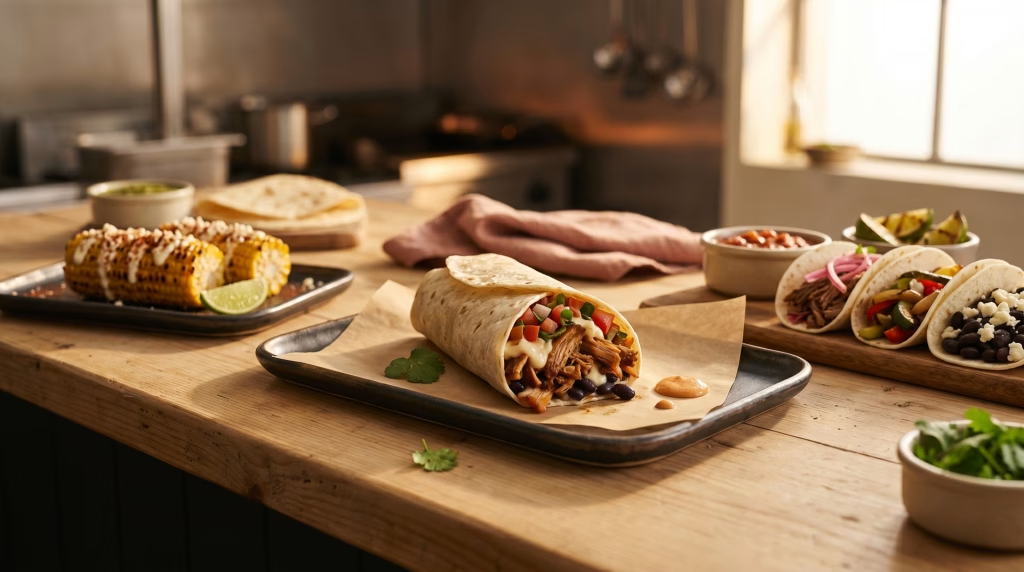
Brand and consumer proposition and Supply chain and procurement
Brand and consumer proposition
Consumer-facing brand, segmentation and reach, occasion ownership, pricing architecture, marketing effectiveness, consumer perception versus operational reality.
Supply chain and procurement
Supplier base, procurement model, supply chain risk and resilience, scaling readiness, ingredient sourcing strategy, cost structure and exposure to commodity movement.

Real estate and operational replicability
Estate strategy, site selection model, format design, lease structure, rollout credibility, the operational replicability that determines whether the model scales beyond its current footprint.

Food and drink is all we do
We are not a generalist M&A advisory firm that takes the occasional QSR mandate. Food and drink is the only sector we work in. Our senior team has operated in QSR and the wider food and drink industry directly, which is why the work reads as operationally credible to other operators. Briefs land with people who get it on the first read, and recommendations come back framed for the people who actually have to make the decision.
That focus is why we work with 11 of the UK’s top 40 food and drink brands.
Other ways to decode QSR and the wider category
QSR operation review is one tool in the broader Decode toolkit. Depending on the brief, one of these might be a better fit, or a stronger partner alongside the review work.
-

Food Safaris & Competitor Review
Live, curated immersion in the markets, restaurants, retail aisles and overseas territories that are shaping your category.
-

Consumer and Category Data Immersion
Structured deep-dives that bring marketing, NPD, innovation or category teams up to a senior working understanding of the category, the consumer and the competitive landscape.
-

Usage and Attitude
Foundational quantitative consumer research that maps category usage, brand awareness, consumer attitudes and the drivers of choice across the audiences that matter.
-

Opportunity Mapping
Strategic mapping of where to play in food and drink.

QSR reviews that landed in real decisions
Three real QSR operation review projects across different brief types.


FAQs
Who actually runs the QSR review work?
Senior food and drink specialists with primary QSR operating experience. Former buyers, NPD leads, operations directors, supply chain heads, real estate principals. The senior person you meet on the scoping call is the senior person who runs the review and presents the recommendation. No handover to junior analysts or freelancers between scoping, delivery and debrief.
How is this different from a big four M&A advisory team on a QSR deal?
Two structural differences. First, the operating bias: our senior team has actually run QSR operations, where big four diligence teams typically have analytical experience but not operating experience. Second, the sector specialism: food and drink is the only sector we work in, where big four advisory covers every sector. The result is a review that reads as operationally credible to other operators, which matters when the audience for the work is a QSR-experienced board or deal team.
Do you actually visit the sites, or is this desk research?
Both, sequenced correctly. The desk-based intelligence build is the foundation (financial filings, trade press, real estate filings, supplier relationships, operational signal from public and proprietary sources). The primary site visits are where the operational reality gets read: peak service, off-peak, multi-unit comparison, mystery shopping. Where the brief allows it, the primary observation is run across multiple sites in the estate, not just at a flagship.
Can you do this discreetly for an acquisition?
Yes. Discretion is a standard feature of the work, not an exception. We operate under NDA throughout, the senior team is small and named on the engagement, primary observation is run without the target operator being aware where that is appropriate, and the deliverable is built for the audience that has to see it (deal team, investment committee, board) without surfacing more widely than agreed. The protocols are designed for M&A and PE work.
What is covered in an operational review?
Five lenses, run together: operations and unit economics, menu architecture and food, brand and consumer proposition, supply chain and procurement, real estate and operational replicability. The cross-functional integration is the value: the operational reality, the menu architecture, the supply chain and the rollout case have to be read together to land a commercially credible recommendation, and that integration is the part most generalist reviews skip.
Can you review QSR brands outside the UK?
Yes. We run international QSR reviews across mainland Europe, the US, the UAE and further afield. International work is run with senior FIS Group leads alongside trusted local specialists, so the on-the-ground operational read has both the FIS Group quality bar and the local market knowledge.
How long does a QSR review take?
A focused competitive review on a single operator typically runs four to six weeks from brief to debrief. M&A diligence and deeper benchmark work typically runs six to ten weeks depending on the operator scope, the primary observation requirement and the audience for the deliverable. Compressed timelines are possible for deal-driven work where the timeline is dictated by the transaction.
Can this be used for due diligence?
Yes. The work is run in a form deal teams and investment committees can use, and is designed to sit alongside (rather than replace) the financial and legal diligence streams. Most M&A and PE buyers commission the operational review as one workstream inside a broader diligence process. We will scope the engagement around the diligence calendar and the audience for the deliverable.
What does the deliverable actually look like?
A structured written report and a debrief session, scoped to the audience. For M&A and PE work, the deliverable is typically formatted for a deal team or investment committee: executive summary, the five lenses, integrated commercial read, recommendation against the original brief. For competitive review and benchmarking work, the deliverable is typically formatted for an internal commercial or leadership audience. Format is agreed at the start.
How much does it cost?
Project-based, scoped around the operator scope, the depth of primary observation, the geographic scope and the discretion required. UK competitive review work is the lowest entry point; international M&A diligence with primary observation across multiple territories is the highest. We give a clear, all-in quote at proposal stage with no hidden extras, and we will tell you straight if your budget will not buy the depth your brief requires.
Got a QSR operator you need to understand operationally?
Tell us the operator (or operators), the commercial question the review has to inform, and the level of discretion required. We will tell you whether a QSR operation review is the right answer, what depth makes sense, what we can credibly cover, and what it will cost. Twenty minutes on a call, under NDA from the start if the brief requires it.
Senior operators, not analysts. Primary observation where the brief allows. NDA-protected throughout. Specialists in food and drink, only.